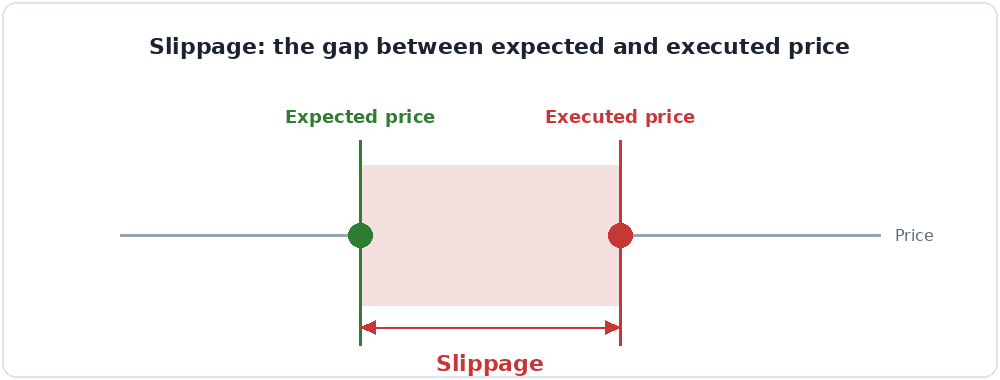
O slippage no mercado Forex é a diferença entre o preço que um trader esperava para uma ordem e o preço pelo qual a ordem foi executada. É uma parte normal do trading, mas pode ser medido e gerenciado. Este artigo explica o que é slippage, por que ele acontece e como controlá-lo.
Resposta Rápida: Slippage é a diferença entre o preço esperado de uma negociação e o preço em que ela é efetivamente executada. Ocorre porque os preços se movem entre o envio de uma ordem e sua execução, e porque a liquidez disponível pode diferir do preço cotado. O slippage pode ser positivo ou negativo. Os traders o controlam principalmente usando ordens limite, incluindo IOC limite e FOK limite, em vez de ordens a mercado simples.
O que é Slippage no Forex?
Quando você envia uma ordem a mercado, você aceita o melhor preço disponível no momento. Mas entre o momento em que a ordem é enviada e o momento em que é executada, o mercado pode se mover, e a liquidez disponível ao seu preço esperado pode ser consumida. A ordem então é executada a um preço ligeiramente diferente. Essa diferença é o slippage.
Por que o Slippage Acontece
O slippage tem algumas causas comuns. Movimentação de preço é o principal: em um mercado rápido, o preço simplesmente muda na fração de segundo entre o envio e o preenchimento de uma ordem. Liquidez fina caso não haja volume suficiente disponível ao preço cotado, parte da ordem é executada ao próximo preço disponível. Volatilidade e notícias aumente acentuadamente ambos os efeitos, pois os preços se movem rapidamente e a liquidez pode diminuir em torno de anúncios importantes. E latência — o atraso entre o trader e o ponto de execução — amplia a janela em que o preço pode se mover.
Deslizamento positivo e negativo
O slippage nem sempre é ruim. Slippage negativo significa que a ordem foi executada a um preço pior do que o esperado. Slippage positivo significa que foi executado a um preço melhor. Em muitas negociações, ambos ocorrem. O objetivo de gerenciar o slippage não é eliminá-lo — isso não é possível — mas mantê-lo pequeno e previsível, para que não corroa silenciosamente os resultados.
Qual o slippage normal?
Não existe um único valor “normal”. Em condições calmas em um par de moedas, o slippage em uma ordem de mercado é frequentemente muito pequeno. Em torno de notícias importantes, em instrumentos ilíquidos ou nas aberturas de sessão, ele pode ser bem maior. O que importa é medir seu próprio slippage ao longo do tempo, em vez de assumir que ele é zero — porque um custo que você não mede é um custo que você não pode gerenciar.
Como Controlar o Slippage
Várias medidas práticas reduzem o escorregamento ou o tornam previsível.
Use ordens limitadas em vez de ordens a mercado. Uma ordem limitada executa apenas a um preço especificado ou melhor, portanto, não pode ser preenchida a um preço pior do que o que você definiu. A contrapartida é que ela pode não ser preenchida de forma alguma.
Use ordens IOC (Immediate or Cancel) e FOK (Fill or Kill). Essas ordens limite limitam o preço e também controlam o quão completamente a ordem será executada — as ordens IOC executam o que podem imediatamente e cancelam o restante, e as ordens FOK executam integralmente ou nada. Ambas convertem o *slippage* de um resultado em aberto para um resultado limitado.
Esteja ciente do tempo. O slippage tende a ser maior em torno de grandes lançamentos de notícias e em momentos de baixa liquidez. Negociar instrumentos líquidos durante sessões ativas o reduz.
Reduzir latência. Uma conexão mais direta com o corretor encurta a janela em que o preço pode se mover antes que seu pedido seja executado.
Como a API FIX do Terminal Ajuda a Controlar o Slippage
O Terminal FIX API se conecta diretamente à corretora através do protocolo FIX API, o que proporciona um caminho mais direto para a execução. Ele suporta os tipos de ordem Limit IOC e Limit FOK, e pode substituir as ordens de mercado utilizadas por um robô MQL por ordens Limit IOC ou Limit FOK — em modo totalmente automatizado e sem alterar o código do robô. Isso permite que uma estratégia escrita com ordens de mercado seja executada com preços de execução limitados. O slippage não pode ser removido completamente, mas essas ferramentas o tornam algo que um trader pode controlar, em vez de simplesmente absorver.
Perguntas Frequentes
O que é slippage no trading de Forex?
Slippage é a diferença entre o preço que um trader esperava para uma ordem e o preço no qual a ordem foi efetivamente executada.
Por que ocorre o slippage?
O slippage acontece porque os preços se movem entre o envio e a execução de uma ordem, porque a liquidez ao preço cotado pode ser limitada e porque a volatilidade, notícias e latência ampliam ambos os efeitos.
Qual a diferença entre slippage positivo e negativo?
Slippage negativa significa uma ordem executada a um preço pior do que o esperado; slippage positiva significa que ela foi executada a um preço melhor. Ambas ocorrem ao longo do tempo.
O slippage pode ser eliminado completamente?
Não. O slippage não pode ser inteiramente removido, mas pode ser mantido pequeno e previsível, principalmente usando ordens limitadas, como Limit IOC e Limit FOK, em vez de ordens de mercado simples.
Ordens limite impedem derrapagem?
Uma ordem limite não pode ser executada a um preço pior do que o que você definiu, portanto, ela limita o deslizamento. A contrapartida é que a ordem pode não ser executada de forma alguma se o mercado não atingir o preço limite.
A negociação com a API FIX ajuda com o slippage de várias maneiras: * **Execução mais rápida:** A API FIX permite que você envie e receba ordens diretamente para e do seu provedor de liquidez com latência mínima. Essa execução mais rápida significa que você pode executar suas negociações com mais rapidez, bem antes que as condições do mercado mudem significativamente e causem slippage. * **Melhor acesso à liquidez:** Aających da API FIX, você pode se conectar a um pool maior de provedores de liquidez. Isso lhe dá acesso a mais liquidez a qualquer momento, o que pode ajudar a reduzir o slippage, pois há mais contrapartes disponíveis para corresponder às suas ordens. * **Ordem e roteamento mais inteligentes:** A API FIX permite que você implemente estratégias de roteamento de ordens mais sofisticadas. Você pode configurar sua API para rotear ordens para os provedores de liquidez mais adequados com base em fatores como preço, profundidade do livro e tempo de resposta. Isso pode ajudar a garantir que suas ordens sejam executadas nas melhores condições possíveis, minimizando o slippage. * **Transparência e controle aprimorados:** A API FIX fornece um alto nível de transparência sobre o processo de execução de ordens. Você tem visibilidade sobre a jornada da sua ordem, desde o envio até a execução. Esse controle e transparência aprimorados permitem que você monitore e gerencie melhor o slippage. * **Algoritmos de negociação personalizados:** Para traders algorítmicos, a API FIX é essencial. Ela permite que você implemente e execute algoritmos de negociação personalizados que podem ser projetados para gerenciar o slippage ativamente. Esses algoritmos podem otimizar o momento e a forma como as ordens são colocadas com base em dados de mercado em tempo real, reduzindo a probabilidade de slippage adverso. * **Menos intermediários:** Ao negociar com a API FIX, você pode reduzir ou eliminar a necessidade de intermediários, como corretores que podem adicionar latência e possíveis pontos de slippage. A conexão direta com os provedores de liquidez simplifica o fluxo de ordens. Em essência, a API FIX capacita os traders com a velocidade, conectividade e controle necessários para navegar nas condições de mercado dinâmicas com mais eficiência, o que, por sua vez, mitiga o risco de slippage.
O trading com FIX API oferece um caminho mais direto para a corretora e suporta tipos de ordens profissionais. O Terminal FIX API também pode converter ordens de mercado de um robô em ordens Limit IOC ou Limit FOK para delimitar o preço de execução.
Conclusão
O slippage no Forex é a diferença entre o preço esperado e o preço executado. Ele é normal e não pode ser eliminado, mas pode ser medido e controlado — principalmente, escolhendo ordens limite em vez de ordens a mercado e negociando através de uma conexão direta de baixa latência. O Terminal FIX API oferece aos traders os tipos de ordem e a conectividade para fazer exatamente isso.
Baixe a plataforma de negociação FIX API gratuita Aprenda como funciona o trading com a FIX API